Category: Online Income | Reading Time: 9 minutes | Last Updated: June 2026
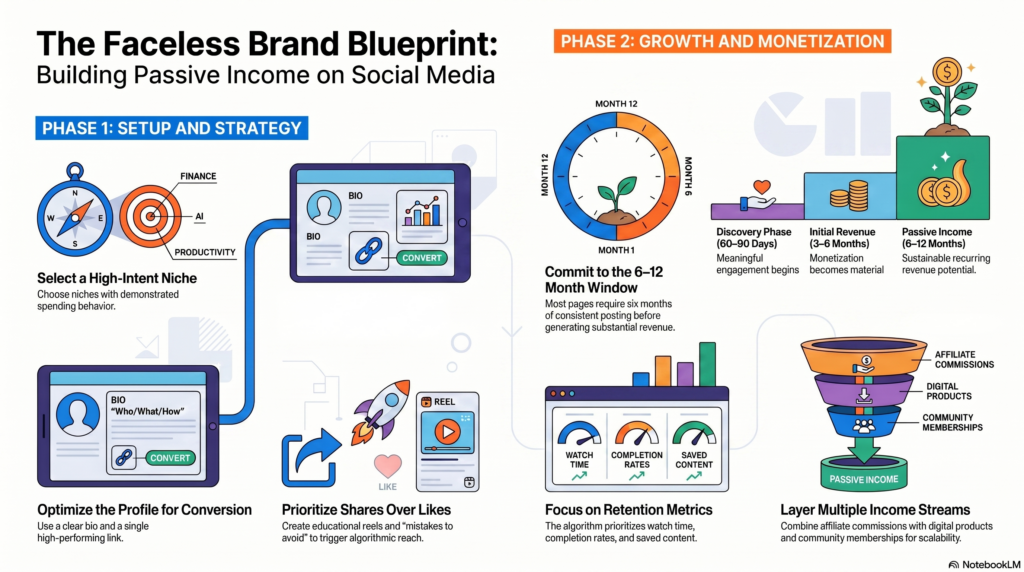
TL;DR: Can you build a real income stream on Instagram or TikTok without ever showing your face? Yes — through a faceless brand. Pick a profitable niche, build a content system, and connect it to affiliate offers or digital products. Most pages that succeed do so within six to twelve months of consistent posting.
Introduction: You Don’t Need to Show Your Face to Build Income Online
The creator economy has fundamentally changed who can participate. Where visibility once required a recognizable personality, today a growing segment of online businesses generates significant income without ever revealing the person behind the content.
Faceless Instagram and TikTok brands — niche-focused pages built around content systems rather than personal identity — have emerged as one of the most accessible entry points into digital entrepreneurship. No camera confidence required. No lifestyle to perform. No personal brand to maintain.
This guide breaks down exactly how these brands work, what monetization models they use, and the step-by-step process for building one — drawing on real creator strategies rather than theory.
What Is a Faceless Social Media Brand?
A faceless brand is a niche content page that builds an audience without any individual as the public face. The content itself — not a personality — is the product.
Rather than operating as an influencer, the page functions as:
- A niche media property
- A content distribution system
- A targeted traffic asset
- A monetization funnel
Common niches for faceless brands include personal development, business and finance, artificial intelligence tools, productivity systems, fitness transformation, and digital marketing. What they share is an audience with both strong interest and demonstrated spending behavior.
The underlying principle is straightforward: attention precedes income. A faceless brand earns money not by being famous, but by consistently attracting the right audience and directing that audience toward relevant products or services.
Why Faceless Brands Have Grown Rapidly
Several converging factors explain the rise of faceless content businesses.
Lower barrier to entry. A creator can launch a page without professional equipment, a pre-existing following, or comfort on camera. A smartphone, a free editing tool, and a content strategy are sufficient to begin.
Scalability. Because no personal presence is required, one individual can run multiple pages across different niches simultaneously — something impossible for traditional influencers whose identity is the product.
AI-assisted production. Tools such as ChatGPT for scripting, Canva for design, and CapCut for video editing have dramatically reduced the time and skill required to produce consistent content.
Privacy and flexibility. Building a business that is not attached to a personal identity offers both lifestyle flexibility and protection from the reputational risks that accompany public-facing brands.
Common Misconceptions About Faceless Brands
Before discussing the how-to, it is worth addressing what faceless brands are not.
They are not passive income from day one. Every successful faceless page requires an initial period of consistent content production, audience development, and system refinement. The passive income potential comes later, once the content system and monetization infrastructure are in place.
Follower count is not the primary objective. A page with 5,000 highly engaged, purchase-intent followers in a monetizable niche outperforms a page with 50,000 passive viewers. Quality of attention matters more than quantity.
AI content without strategy produces poor results. Using AI tools to generate generic content at scale without a clear niche positioning and content angle is one of the most common failure points. AI is most effective as a scripting and ideation tool, not as a replacement for strategic thinking.
How Faceless Brands Actually Generate Income
The faceless page itself is not the income source. It is the distribution channel. Revenue comes from attaching one or more monetization models to the traffic the page generates.
Affiliate Marketing
Promoting third-party products or services in exchange for a commission on resulting sales. This is typically the lowest-friction starting point because it requires no product creation. Effective categories include software subscriptions, productivity tools, online courses, and financial platforms. All these carry meaningful commission rates and align naturally with popular faceless niches. Read The Ultimate Guide to Affiliate Marketing with Digistore24 to learn one of the platforms to get affiliate products.
Digital Products
Downloadable assets such as templates, guides, ebooks, Notion systems, and swipe files. These carry near-zero marginal cost once created and can be sold repeatedly. Digital products are particularly effective because they can be deeply relevant to the specific niche, making conversion rates significantly higher than generic affiliate offers. How to Make Passive Income Online with Digital Products (Even as a Beginner) will guide you if you are new to this.
Online Courses and Educational Products
Either original courses or promoted programs from established creators. This model works best once a creator has enough audience data to understand what problems their followers most want solved.
Community Memberships
Platforms such as Skool allow creators to build paid or free-to-join communities where deeper monetization takes place through premium tiers, coaching, or partner offers. The faceless page functions as the top of the funnel; the community deepens the relationship and captures more revenue per member.
Brand Sponsorships
As pages scale, direct sponsorship from brands whose products align with the niche becomes viable. This is generally a later-stage revenue stream rather than a starting point.
The pages that generate the most sustainable income typically combine multiple models — affiliate commissions for immediate cash flow, digital products for scalable revenue, and community or course offers at the higher end.
Step-by-Step: How to Build a Faceless Brand
Step 1: Select a Profitable Niche
Niche selection is the most consequential early decision. The criteria are simple: the niche must have both demonstrated audience interest and an established monetization ecosystem.
Strong candidates include personal finance and wealth building, digital entrepreneurship, AI tools and automation, career advancement, fitness and nutrition, and mindset and productivity. These niches have large audiences, active communities, and a wide range of affiliate programs, digital products, and courses already generating revenue.
Avoid niches that are purely entertainment-focused or that lack a clear path to commercial intent.
💡 Pro Tip: Use this “Top 100 Niche Ideas” list to fast-track your decision.
Step 2: Build a Profile Designed to Convert
The page profile is a functional component of the business, not decoration. Every element should work toward a single outcome: converting a visitor into a follower, and a follower into a customer.
Effective profile structure:
- Username: Simple, niche-relevant, and easy to remember
- Bio: A single clear sentence in the format — “Helping [audience] achieve [specific result] through [content angle]”
- Link in bio: A single destination, either a landing page, a digital product, or a link aggregator (Beacons or Stan Store perform well for this)
- Profile image: A clean logo or niche-relevant icon that reinforces the brand identity
Step 3: Create Content That Gets Shared
The metric that matters most on short-form platforms is not likes — it is shares and saves. Content that viewers share with others or save for later signals the algorithm to extend reach significantly.
Content formats with strong organic performance:
- Educational reels with clear, actionable takeaways
- “Mistakes to avoid” style videos, which perform well because they trigger both curiosity and fear of loss
- Opinion-driven content that takes a clear position
- Step-by-step tutorials relevant to the niche
Every piece of content should open with a hook that communicates the value within the first two to three seconds. Viewers make the decision to continue or scroll past almost immediately.
Recommended tools: Canva (graphics and templates), CapCut (video editing), ChatGPT or Claude (scripting and ideation), Buffer (scheduling).
Step 4: Post Consistently
A realistic and sustainable publishing cadence for a new page is one to two posts per day or a minimum of five to seven posts per week. The specific number matters less than the consistency.
The most common reason faceless pages fail is not poor content — it is abandonment. Most pages that do not succeed are simply discontinued before the compounding effects of consistent posting have time to take hold.
Step 5: Optimize for Platform Algorithms
Both Instagram and TikTok prioritize content that demonstrates strong viewer behavior signals. The factors with the greatest impact are:
- Watch time and completion rate: The percentage of viewers who watch the full video
- Saves: Viewers bookmarking content for later
- Shares: Viewers sending content to others
- Early engagement: Interactions in the first hour after posting carry disproportionate weight
Understanding that the algorithm is responding to viewer behavior — not effort or output volume — reorients how creators should think about content quality.
Step 6: Add Monetization Early
A common mistake is waiting until a page reaches an arbitrary follower milestone before introducing monetization. Even pages with modest audiences can generate income if the audience is targeted and the offer is relevant.
A sensible sequencing: begin with affiliate links tied directly to niche-relevant products, then introduce a low-ticket digital product, then develop higher-value offers as audience understanding deepens.
Key Success Factors
Based on the performance patterns of successful faceless brands, the following variables most consistently separate pages that generate income from those that do not:
Niche specificity. The more precisely defined the audience, the higher the conversion rate on any monetization offer.
Content-to-offer alignment. Every piece of content should either build trust, demonstrate expertise, or create awareness of a problem that the page’s monetization offer solves.
Patience during the growth phase. Most faceless pages that become meaningful income assets required six to twelve months of consistent effort before generating substantial revenue. The compounding nature of algorithmic content distribution means early growth is slow and later growth accelerates.
System over inspiration. Pages that rely on creative inspiration produce inconsistently. Pages that operate as content systems — with defined content pillars, repeatable formats, and scheduled production — compound reliably.
Frequently Asked Questions
How much can a faceless brand realistically earn? This varies widely by niche, audience size, and monetization model. Pages with engaged audiences of 10,000 to 50,000 followers in high-intent niches regularly generate $1,000 to $5,000 per month through affiliate commissions and digital product sales. Larger pages with multiple income streams can generate substantially more.
Do I need a large following before I can make money? No. A small, targeted audience with strong purchase intent can generate income before a page reaches 1,000 followers. The key is offer-to-audience alignment, not follower count.
Which platform is better — Instagram or TikTok? Both have significant advantages. TikTok offers stronger organic reach for new accounts. Instagram provides more stable, long-term audience relationships and broader content formats including Stories, Reels, and posts. Many successful creators use TikTok for discovery and Instagram for depth.
How long does it take to see results? Most pages begin to see meaningful engagement within 60 to 90 days of consistent posting. Monetization typically becomes material between months three and six. Significant passive income potential generally requires six to twelve months of sustained effort.
Conclusion
Faceless brands represent a genuinely accessible model for building an online income stream. They require no camera presence, minimal technical skill, and a modest initial investment of time. What they do require is a clear niche, a disciplined content system, and a well-constructed monetization strategy.
The opportunity is real. The mechanics are learnable. The primary variable is execution.
For those willing to treat a faceless page as a media business rather than a content hobby, the potential to build a scalable, recurring income stream is well within reach.
Want the shortcut?
Everything in this guide is expanded into a full course inside Digital Quick Start, my Skool community for people building faceless brands and digital income streams. If you’d rather follow a proven roadmap than figure it out alone, this is where to start.
This article is for informational purposes. Individual results from building social media brands vary based on niche selection, content quality, consistency, and monetization strategy.